
BLACK HISTORY MONTH CELEBRATION WITH THE
MICHIGAN CITY CHAMBER MUSIC FESTIVAL
Sunday, February 23
3PM
Head Start
Michigan City, IN
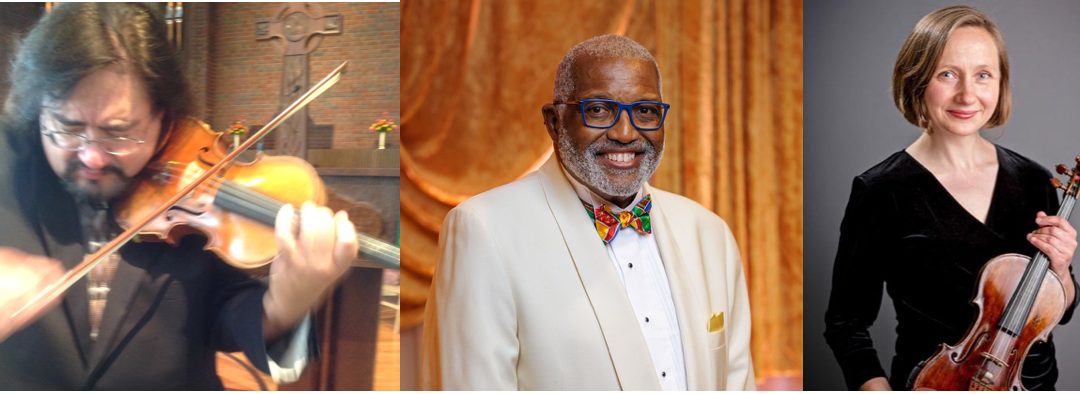
The Michigan City Chamber Music Festival (MCCMF) is very proud to present a “Black History Month Celebration” concert! The program will take place on Sunday, February 23, 3:00 p.m. central, at Head Start (formerly Niemann Elementary School), 811 Royal Rd, Michigan City, IN. Violinists Nic Orbovich & Zofia Glashauser will present music by Joseph Bologne (Chevalier St. George’s), Sergei Prokofiev, Jesse Montgomery, Scott Joplin, and John Philip Sousa. They will be joined by Dr. Marvin Curtis, who will show the trailer for “Invisible Player,” an upcoming documentary about Rosemary Sanders, the first African American member of an American symphony orchestra in 1940.
In 1940, 19-year-old Rosemary Sanders became the first African American musician in the South Bend Symphony Orchestra and probably in America. This project, Invisible Player, is designed to present the historical narrative of Rosemary Sanders and highlight the racial barriers African Americans face in American orchestras. The film uses Rosemary’s story as a jumping off point to explore where the American orchestral industry is today, how we got here, and possible paths forward. Sanders prepared for her audition with years of private study with South Bend’s concertmaster, the lead violinist of the Symphony. During high school, she traveled from South Bend, Indiana, to Chicago with her mother on the segregated South Shore train line to study as the only African American student at the Sherwood School of Music at Columbia College. Through the generosity of her family’s employer, Gertrude Oliver Cunningham, she was given a Stradivarius violin, one of the most prized string instruments in the world. Despite her obvious talent as a violinist, when she joined the South Bend Symphony, she was assigned to the last seat in the second violin section. The audience could not even see her. For the fifteen years she performed with the orchestra, her name was never listed in the program. She was never included in formal pictures of the orchestra. Her musical background and first-class instrument notwithstanding, she was never allowed to advance from the last seat, where she was invisible to the audience. Upon her leaving the orchestra, the next African American member of the South Bend Symphony would not join until 1995, 32 years later.
With Rosemary excluded from orchestral history, records list Denver Symphony bassist Charles Burrell as the first African American player in an American orchestra in 1949. The deliberate exclusion of Rosemary Sanders from the history of the South Bend Symphony is emblematic of racist policies of the Jim Crow era. Yet many these policies have persisted long past the formal end of Jim Crow, and have resulted in the continued racial disparity between African American players and white players. Even when included as members of American orchestras, many players find themselves to be “invisible” among their fellow musicians. In 2014, there were 1,224 orchestras in the US, and African Americans comprised just 1.8% of the players, based on data provided by the League of American Orchestras. In 2024, there were roughly 2,000 orchestras in America, and the number of African American players had grown to 2.4%, while other racial groups, such as Latino/Hispanic players, expanded from 2.5% to 4.8%, and Asian players grew from 9.2% to 11%.
The history of Rosemary Sanders and South Bend in Invisible Player will show why American orchestras have remained so out-of-step with the demographics of their communities. The film explores Sanders’ background and life in South Bend, her relationship with her benefactor, Gertrude Oliver Cunningham, her symphony experience, and how she dealt with the racial climate in the city after leaving the symphony. Her life story exemplifies the continuing lack of diversity in American orchestras. Our project covers topics such as the past and present racial challenges that African Americans face and have faced, including the lack of arts education in communities of color and its effects on the pipeline of potential players. I survey solutions that are being developed to address the problem. Orchestras still look much as they did when Rosemary Sanders was playing. Will things ever change? Dr. Curtis is currently traveling the country looking for answers. He began working locally in the archives with the South Bend History Museum and the St. Joseph County Library.
Working with the film team of videographer Ryan Blaske and director Chuck Fry and my co-producer Justus Zimmerman, we have recorded extensive interviews with Sanders’ daughter, Helen Binion-Ursey. He, with MCCMF Artistic Director Nic Orbovich, visited the Detroit Conference of the Sphinx Organization, whose mission is to address the systemic lack of access in classical music by Black and Latino communities, and interviewed many participants, including Aaron Dworkin, its founder. Simon Woods, president and CEO of the League of American Orchestras, the 700-member service organization, sat for an interview at their Houston conference. Former Executive Director Lee Koonce and new Executive Director Alexander Laing of the African American Gateways Music Festival Orchestra gave their insight. Lee Pringle, the founder of The Colour of Music Festival of Charleston, South Carolina, outlined his distinctive views. Interviews are being scheduled and conducted with many African American players and managers who are navigating the current landscape and dealing with current challenges. All share their hopes and fears about the future. They are charting a course whereby American orchestras can reach their full, diverse potential. The story of Invisible Player will be told in a 90-minute film, with me serving as guide, narrator, and executive producer.
Since Sander’s history was not readily available, I researched her South Bend story using primary source materials provided by her daughter and Sander’s writings. Additional research has been conducted into the racial climate that led to the inclusion of African Americans in the five largest American orchestras. This complicated history focuses on the orchestral and musician union climate that left many of these players feeling invisible. I’ve had discussions with arts leaders concerning the role of arts education, access, and different schools of thought for diversifying the orchestral landscape. These discussions have yielded contentious viewpoints revolving around the fundamental conflict: should African American ensembles be self-sustaining, or should players pursue immersion into the orchestral landscape, or is there a compromise?
The South Bend Symphony will provide a musical soundtrack utilizing music Sanders would have performed, as well as works of African American composers. We have commissioned a new work by African American violinist and composer Jessica Carter of South Bend. Invisible Player seeks to expose an injustice, examine the rationale for that injustice, and offer solutions to create a more equitable and inclusive art form. This film tackles a subject with broad implications for the future. I anticipate very extensive dissemination of the film, beginning with its submission to film festivals. From there, it is designed for viewing everywhere high-quality documentaries are available. The film is designed to be a tool for American orchestras to acknowledge the past and make changes for a positive future.
Zofia Glashauser is a member of the Knoxville Symphony, and has been the concertmaster of the South Bend Symphony Orchestra and the Lira Orchestra of Chicago. With these orchestras, she has soloed on violin concertos by Tchaikovsky, Vieuxtemps, Mozart, and on brilliante works by Wieniawski and Kreisler. These performances were lauded by audience and critics alike, and has helped garner her a reputation as one of the American midwest’s most sought-after violinists. Her playing is characterized by, and well-known to audiences, as having a sublime, yet fiery passion and a fine, crystalline technique.
Ms. Glashauser was born in the beautiful and historically rich city of Krakow, Poland. Upon her arrival in America, she was immediately accepted into the studio of renowned pedagogue, Renata Knific at Western Michigan University. While there, Zofia was both a winner of the 2001 concerto competition and a semi-finalist in the Fischoff National Chamber Music Competition. She then continued her studies in the Chicago, IL area at Northwestern University as a master’s candidate in the acclaimed combined studio of Roland and Almita Vamos.
She is an avid performer today, having been a member of the Civic Orchestra of Chicago, the Kalamazoo Symphony, and assistant concertmaster of the Northwest Indiana Symphony. With these, and other orchestras, she has worked under conductors Daniel Barenboim, Claudio Abbado, and Sir Neville Mariner.
Zofia is also a very active chamber musician, being a violinist with the acclaimed Michigan City Chamber Music Festival, was first violinist with the South Bend Symphony String Quintet, and continues to perform chamber music around the country.
In 2016, Zosia (as she is affectionately known to friends) won a full time position with the Knoxville Symphony Orchestra in Tennessee. She lives there, where she keeps an active and thriving private teaching studio. She enjoys many activities, including cooking, reading, and especially running, having participated in numerous races.
Nicolas Paul Orbovich enjoys a high reputation among adventurous American violinists. His highly acclaimed career spans a wide variety of musical styles and genres, while expanding into prolific artistic entrepreneurial endeavors.
As a performer, Nic has been honored widely. He was a soloist in the world premiere of “Epitaph” by Jaroslaw Golembioski in 2024. In this performance, he was honored by being selected to perform on one of the storied “Violins of Hope” accompanied by the Lincolnwood Chamber Orchestra in Chicago. In 1987, he was awarded the Bronze Medal at Her Royal Majesty’s International Festival Competition in Aberdeen, Scotland (UK). Orbovich was also a semi-finalist at the 1995 Fischoff National Chamber Music Competition as a member of the Amherst String Quartet. In 2001, he was featured as a soloist on the Grammy Award nominated release, “The Hot Springs Music Festival: Louis Moreau Gottschalk” (Naxos). That same year, Nic was a prominent figure in the Emmy Award winning documentary, “The Sound of Dreams.” In 2008, Nic was concertmaster on a “Top Ten of the Year” selection of Gramophone Magazine, “Rudolf Haken; Concertos” (Naxos). He has soloed with numerous orchestras around the country, having performed concertos and brilliante works by Wieniawski, Vieuxtemps, Sarasate, J.S. Bach, Beethoven, and Vivaldi.
In January,2025, Nic addressed the renowned Sphinx Conference audience in Detroit, MI, as part of an exclusive panel that discussed classical music’s role in extending opportunities to traditionally underserved communities. In this realm, Nic has been nationally recognized as a pioneer in showcasing music from African/American, Latino, Female, Muslim, Jewish, and LGBTQ musicians.
He enjoys a reputation as an outstanding recording artist in many genres. Besides the aforementioned Grammy nominee and Gramophone magazine award winner, Nic appears in “The Hot Springs Music Festival; Creole Romantic Composers” (2001-Naxos), “Music of Jerome Moross” (2002-Naxos), “Music of Jerome Starer” (1997-Albany), and appears on an album of jazz violinist Diane Delin.
As orchestral performer, his work is prolific. Nic has been concertmaster of the South Bend Symphony, the Hot Springs Festival Orchestra, the Southwest Michigan Symphony, the LaPorte Symphony, the Lake Shore Symphony and many others. In this role, he has performed on stage with some of the most acclaimed names in classical music. Some of those names include; Itzhak Perlman, Yo Yo Ma, Gidon Kremer, Joshua Bell, Andre Watts, Hilary Hahn, Lang Lang, Garrick Ohlson, Shlomo Mintz, Daniel Barenboim, Lorin Maazel, Leonard Slatkin, and Sir Georg Solti. Currently, he holds the Principal Second Violin chair with the South Bend Symphony Orchestra (SBSO), where he is also a member of the SBSO String Quartet and String Quintet, performing over 20 concerts a year with those chamber ensembles.
Nic’s favorite form of musical expression is through chamber music. His involvement with existing ensembles and musicians is prodigious. He has coached with Rostislav Dubinsky (Borodin String Quartet), Alexander Schneider (Budapest Quartet), and Alan Grishman (Mendelssohn String Quartet). Orbovich has performed “Quintet” by Sergei Prokofiev with Rachel Barton Pine, the “Sonata for Violin & Piano” with Christopher O’Reilly, and other chamber works with Nathan Gunn, Nancy Ambrose King, members of the Chicago Symphony Orchestra, Lyric Opera of Chicago Orchestra, and the Pittsburgh Symphony. His performances of chamber music have been featured on National Public Radio’s “Performance Today.”
He is the co-founder (with wife Sunny) of the Michigan City Chamber Music Festival (MCCMF), and performs as violinist in their annual concerts. Through his leadership and dedication, the MCCMF is quickly becoming recognized as one of the country’s best chamber music festivals. In 2013, he was the guest speaker at the Indiana Suzuki Teachers Conference, where he delivered an address on the importance of teaching chamber music to young musicians.
Orbovich is equally dedicated to music education. He has been on the faculties of Valparaiso University, Andrews University, Bethel College, Illinois Valley Community College, the Hot Spring Music Festival, and the Donald A. Dake Chamber Music Chamber Music Academy. Currently, Nic has a thriving private violin/viola studio in Michigan City, IN. As a member of the South Bend Symphony String Quartet and Quintet, he performs 25 interactive and educational concerts for school children each year. During the aforementioned Michigan City Chamber Music Festival, he facilitates daily presentations for elementary aged students at the local public library during the week long event. He also has taken the “Every Child Can” pre-Suzuki school training, which specializes in early childhood musical development.
Nic has garnered much attention in the “pop” genre as well. He has performed on stage with such popular artists as Harry Connick, Rod Stewart, Amy Grant, Michael Bolton, Clay Aiken, Arturo Sandoval, Tony Bennett, the Duke Ellington Big Band, Frank Sinatra Jr., Bobby Vinton, the Moody Blues, Yanni, Roger Daltry, Kansas, Melissa Manchester, Ben E. King, Tito Puente Jr., Ben Vereen, the Platters, the Ink Spots, Barbara Mandrell, and is a regular member of Mannheim Steamroller, just to name a few.
Nic lives in Michigan City, IN with his lovely wife Sunny and beautiful daughter, Sophia. He also enjoys many altruistic and philanthropic endeavors. Orbovich serves on the Board of Directors of the Keys to Hope Drop In Resource Center (a Center for the homeless), the Recovery House of Michigan City, volunteers at the Community of Faith Men’s Shelter, the Michigan City Soup Kitchen, and has served on the Board of Directors of the Dunes Fellowship Recovery House.
This groundbreaking and important concert will take place on Sunday, February 23, 3:00 p.m. at Head Start (formerly Niemann Elementary), 811 Royal Rd, Michigan City, IN. The following day, 2/24/2025, the MCCMF will present Black History Month in schools programs for area students in local schools.
Follow the MCCMF on Facebook (Michigan City Chamber Music Festival), YouTube (Michigan City Chamber Music Festival), or www.mccmf.org. Call (219) 561-1939 for more information.